All Around The World

All Around The World

Wednesday, March 5, 2014

France – The Church’s Older Daughter

Famous for its wines and cheeses, France is the world’s most popular tourist destination receiving 82 million foreign tourists annual. Visitors are attracted by historic cities, a beautiful countryside, the castles of the Loire Valley, and Brittany and Normandy. In addition, France offers an agreeable climate, some excellent beaches on the French Riviera, the Atlantic coast and the island of Corsica, wide possibilities for winter sports , most notably in the Alps and the Pyrenees, and a rich culture with food and wines that are among the most celebrated in the world.


France, which also have the names of “The Church’s Older Daughter”. France, a city of 66,021,744 people, is a sovereign country in Western Europe that includes overseas regions and territories. Metropolitan France extends from the Mediterranean Sea to the English Channel and the North Sea, and from the Rhine to the Atlantic Ocean. It is one of only three countries (with Morocco and Spain) to have both Atlantic and Mediterranean coastlines. Due to its shape, it is often referred to in French as l’Hexagone. France is a unitary semi-presidential republic with its capital in Paris, the nation's largest city and the main cultural and commercial centre. 


  • Eiffel Tower
The Eiffel Tower is a symbol of Paris and one of the top tourist attractions in France. The tower was built by Gustave Eiffel as the entrance arch for the International Exhibition of Paris of 1889. Since its construction more than 200,000,000 people have visited the Eiffel Tower making it the most visited paid tourist attraction in the world. The tower has three levels for visitors, with restaurants on the first and second. The third level observatory's upper platform is 276 m (906 ft) above the ground, the highest accessible to the public in the European Union. Tickets can be purchased to ascend by stairs or lift (elevator) to the first and second levels. The climb from ground level to the first level is over 300 steps, as is the walk from the first to the second level. Although there are stairs to the third and highest level, these are usually closed to the public and it is generally only accessible by lift.


  • Mont Saint-Michel
Mont Saint-Michel is an island commune in Normandy, France. It is located approximately one kilometre (0.6 miles) off the country's northwestern coast, at the mouth of the Couesnon River near Avranches. 247 acres (100 ha) in size. The island has held strategic fortifications since ancient times, and since the eighth century AD has been the seat of the monastery from which it draws its name. The structural composition of the town exemplifies the feudal society that constructed it. On top God, the abbey and monastery, below this the Great halls, then stores and housing, and at the bottom, outside the walls, fishermen and farmers' housing. Its unique position of being an island only 600 metres from land made it readily accessible on low tide to the many pilgrims to its abbey.


  • Chateau de Chambord
The royal Château de Chambord at Chambord, Loir-et-Cher, France, is one of the most recognizable châteaux in the world because of its very distinct French Renaissance architecture which blends traditional French medieval forms with classical Renaissance structures. The building, which was never completed, was constructed by King François I. At the heart of Europe's largest enclosed wooded park (around 19 mi² enclosed by a 20 mile-long wall), Chambord, the dream of a young king and a marvel of the Renaissance period, is the largest château in the Loire Valley. It boasts a pleasure garden and a hunting park both listed as Historical Monuments.


Australia – The Lucky Country

Australia is a unique and diverse country in every way - in culture, population, climate, geography, and history. Australian culture is as broad and varied as the country's landscape. Australia is multicultural and multiracial and this is reflected in the country's food, lifestyle and cultural practices and experience. Australia has an important heritage from its indigenous people, which plays a defining role in the cultural landscape. This diversity of influences creates a cultural environment in Australia that is lively, energised, innovative and outward looking. The majority of Australia experiences temperate weather for most of the year. The northern states of Australia are typically warm all the time, with the southern states experiencing cool winters but rarely sub-zero temperatures. Snow falls on the higher mountains during the winter months, enabling skiing in southern New South Wales and Victorian ski resorts, as well as the smaller resorts in Australia's island state, Tasmania.


Australia, which also have the names of “The Lucky Country”. Australia, a city of 22,507,616 people, is a country comprising the mainland of the Australian continent, the island of Tasmania, and numerous smaller islands. It is the world's sixth-largest country by total area. Neighbouring countries include Indonesia, East Timor and Papua New Guinea to the north; the Solomon Islands, Vanuatu and New Caledonia to the north-east; and New Zealand to the south-east. Australia has six states—New South Wales (NSW), Queensland (QLD), South Australia (SA), Tasmania (TAS), Victoria (VIC) and Western Australia (WA)—and two major mainland territories—the Australian Capital Territory (ACT) and the Northern Territory (NT). In most respects these two territories function as states, but the Commonwealth Parliament can override any legislation of their parliaments.


  • Sydney

Sydney is the largest and most populous city in Australia and offers a lot of interesting tourist locations. The most famous is, off course, Sydney opera house. It is designed by the Danish architect John Utzon. Tourists are allowed to see the backstage and the front of the house. Beside the Opera house, other tour destinations are the Hunter Valley Wineries, Harbour Highlights Cruises, Jenolan Caves, the marine aquarium at Darling Harbor and many others. Sydney really does shine in summer. There’s no other city in the world that offers so many pristine beaches in such close proximity to the city. Culture enthusiasts will enjoy the Opera House, markets in Sydney and a host of Sydney eventsduring this period. And for those who like to party, don’t missNew Year’s Eve Sydney Festival, Australia Day and Mardi Gras.


  • Tasmania

Tasmania is a place of wild and beautiful landscapes, friendly, helpful people with a relaxed island lifestyle, wonderful wine and food and a haunting history evoked by spectacular convict-era ruins. It's also Australia's smallest state and the most geographically diverse with over 40 per cent of Tasmania reserved as national park and world heritage area. So no matter where you go in Tasmania, whether you spend time in one location or drive around the island, we know you'll be delighted by what you'll find and surprised at how much bigger Tasmania really is on the inside.


  • Kangaroo Island

Kangaroos, koalas, wallabies, penguins, echidnas and bird life all call this island home. Walk amongst a colony of endangered Australian sea lions at Seal Bay. See sleepy koalas in the trees. Load up on fresh produce - from Ligurian honey to free range chickens and eggs - and wine produced by 30 growers from Cape Willoughby to Kingscote. The Island is also home to breathtaking scenery. Rugged coastal cliffs, sheltered bays cupped between steep headlands, vast native bushland and rolling hills of farmland are just some of the breathtaking landscapes on offer. Remarkable Rocks and Admirals Arch are two of Australia’s most fascinating coastal landmarks. Swim on a secret beach at Stokes Bay, surf at Vivonne Bay and fish from Emu Bay. Tour the underground caves at Kelly Hill Conservation Park and immerse yourself in the wilderness of Flinders Chase National Park. With accommodation ranging from five-star clifftop resorts, through to hotels and simple lodgings, there’s something for everyone on 'Kangaroo Island'.


Thailand – Land Of White Elephant

Thailand is the country in Southeast Asia most visited by tourists, and for good reason. You can find almost anything here: thick jungle as green as can be, crystal blue waters that feel more like a warm bath than a swim in the ocean, and food that can curl your nose hairs while tap dancing across your taste buds. Exotic, yet safe; cheap, yet equipped with every modern amenity you need, there is something for every interest and every price bracket, from beach front backpacker bungalows to some of the best luxury hotels in the world. And despite the heavy flow of tourism, Thailand retains its quintessential Thai-ness, with a culture and history all its own and a carefree people famed for their smiles and their fun-seeking sanuk lifestyle. Many travellers come to Thailand and extend their stay well beyond their original plans and others never find a reason to leave. Whatever your cup of tea, they know how to make it in Thailand.


Thailand, which also have the names of “Land Of White Elephant”. Thailand, a city of 67,790,616 people, are located at the centre of the Indochina peninsula in Southeast Asia. It is bordered to the north by Burma and Laos, to the east by Laos and Cambodia, to the south by the Gulf of Thailand and Malaysia, and to the west by the Andaman Sea and the southern extremity of Burma. Its maritime boundaries include Vietnam in the Gulf of Thailand to the southeast, and Indonesia and India in the Andaman Sea to the southwest. Thailand is a unitary state which consists of seventy-six provinces and one special administrative area representing the capital Bangkok. The provinces are part of the provincial government, whilst Bangkok is part of the local government.


  • Phuket

What comes into the mind of travellers when we talk about sea, sun and sand? Phuket must definitely be one of the answers. A number of exciting activities can be found on this island. In the early days of regional maritime trade, the cape of Phuket was locally referred to as Jung Ceylon, while locals called it Thalang, which evolved to be the name of the main town to the north of the island. As the perfect stopover sheltering traders from monsoons, Jung Ceylon welcomed merchants from India, Persia, Arabia, Burma, China, and also Siam. The island's long history has shaped the Phuket of the present with its diverse ethnic groups, culture, architectural influence, and fine cuisine. These attributes have made Phuket a complete tourist destination that offers a lot more beyond its natural heritage of sea, sand, forest, and world-renowned diving sites. Sino-Portuguese architecture casts its spell delighting travellers to the city, while Phuket style of hospitality has never failed to impress visitors from all walks of life.


  • Bangkok

As the political, economic, cultural, culinary, and spiritual capital of Thailand, Bangkok features both old-world charm and modern convenience, at times served up in an apparently chaotic manner, but always with a gracious smile. Invariably, every Thailand holiday includes a visit to the kingdom’s capital city, Bangkok, or Krung Thep, “the city of angels” as it is known to its inhabitants. Many tourists who travel to Bangkok are immediately overwhelmed by the sheer size of the city and the vast number of attractions Bangkok has to offer. While the immensity of the city and its bustling streets can be intimidating at first, those who spend some time in Bangkok are quickly enamored by the myriad of attractions Bangkok contains, from exotic temples, which underscore Thailand’s strong Buddhist history, to modern shopping malls, which make shopping an integral part of any Bangkok holiday. Bangkok features attractions guaranteed to please visitors either simply passing through the city or spending their entire Thailand holiday in Bangkok. Nearly every Bangkok holiday includes a visit to Thailand’s Grand Palace, arguably the premier Bangkok sightseeing attraction. Whether, the purpose of your Thailand holiday is to immerse yourself in Thailand’s unique culture or simply to splurge in Bangkok shopping malls, when you travel to Bangkok you are guaranteed a fascinating experience of both old-world charm and modern convenience and luxury.


  • Chiang Mai

Thailand’s “Rose of the North” is a cultural and natural wonderland with ethnic diversity, a multitude of attractions and welcoming hospitality. Chiang Mai literally means “new city” and has retained the name despite celebrating its 700th anniversary in 1996. Chiang Mai is one of the few places in Thailand where it is possible to experience both historical and modern Thai culture coexisting side by side: the city features centuries-old pagodas and temples next to modern convenience stores and boutique hotels. This dichotomy is best appreciated within the moat-encircled old city, which retains much of the fortified wall that once protected the city center as well as the four main gates that provided access to the former Lanna capital city. Strangely, for many years tourists had mistaken Chiang Mai simply as the base from which they could plan trekking and rafting trips to hill tribe villages and explore other provinces. Once in Chiang Mai, however, tourists are surprised by the fact that there are so many things to discover other than its beautiful and historic temples. Chiang Mai is also blessed with pristine natural resources including mountains, waterfalls, and rivers. Intriguing diversity among ethnic tribes, a number of elephant camps, many cooking and massage schools, numerous outdoor activities, a variety of handicrafts workshops, various cultural performances, and breathtaking scenery make Chiang Mai one of Asia’s most attractive tourist destinations.


Monday, March 3, 2014

Singapore – The Lion City

Though physically small, Singapore is an economic giant. It has been Southeast Asia's most modern city for over a century. The city blends Malay, Chinese, Arab, Indian and English cultures and religions. Its unique ethnic tapestry affords visitors a wide array of sightseeing and culinary opportunities from which to choose. A full calendar of traditional festivals and holidays celebrated throughout the year adds to its cultural appeal. In addition, Singapore offers luxury hotels, delectable cuisine and great shopping! The island nation of the Republic of Singapore lies one degree north of the Equator in Southern Asia. The country includes the island of Singapore and 58 or so smaller islands. Because of its efficient and determined government, Singapore has become a flourishing country that excels in trade and tourism and is a model to developing nations. The capital city, also called Singapore, covers about a third of the area of the main island.


Singapore, which also have the names of “The Lion City”. Singapore, a city of 5,567,301 people, are lies off the southern tip of the Malay Peninsula and is 137 kilometres (85 mi) north of the equator. Made up of the lozenge-shaped main island (widely known as Singapore Island but also as Pulau Ujong, its native Malay name) and over 60 much smaller islets, it is separated from Peninsular Malaysia by the Straits of Johor to its north and from Indonesia's Riau Islands by the Singapore Strait to its south. The country is highly urbanised, with very little primary rainforest remaining. Its territory has consistently expanded through land reclamation. While the small physical size of Singapore does not justify the creation of national subdivisions in the form of provinces, states, and other national political divisions found in larger countries, the city-state is nonetheless subdivided in various ways throughout its history for the purpose of local administration and urban planning.


  • Marine Life Park

Dive into Marine Life Park, the world’s largest oceanarium and be inspired by the myriad marine wonders of our blue planet. Featuring world-class attractions, Marine Life Park takes you and your family on an unforgettable journey. Explore the awe-inspiring universe of life in the ocean at S.E.A AquariumTM, the world’s largest animals from over 800 species across 49 habitats, the aquarium is home to majestic manta rays, enormous goliath groupers, hammerhead sharks and other gentle giants of the sea. Experience a world bustling with thousands of marine animals, and get up close with some of the most majestic creatures of the sea with Ultimate Marine Encounters!


  • Sentosa Island
Just 15 minutes away from the city centre is Sentosa, an idyllic resort island with pristine beaches, world-class attractions, sea sports, golf and retreats. At Sentosa, there are endless activities to indulge your every interest. Our biggest attraction, Imbiah Lookout offers something for everyone; thrill seekers can take a ride on Skyline Luge Sentosa, nature lovers can explore the walking trails and wonders of Butterfly Park & Insect Kingdom or learn about flora and fauna on a guided tour of Sentosa Nature Discovery. For some culture, try Images of Singapore. The sporty side of you can enjoy a game of beach volleyball on Siloso Beach, ride the barreling waves at Wave House Sentosa and at night fall, be awed by Songs of the Sea, a multi-sensory extravaganza. Feeling hungry? Our food for the gourmet soul comes to you in over 50 restaurants from casual to classy, and in every taste. Sentosa enhances your leisure options with a world-class family resort, Resorts World™ Sentosa, great shopping and dining experiences at VivoCity and Harbourfront Centre, the multi-concept entertainment hub at St James Power Station, and nature trail at Mt Faber all located within close proximity to Sentosa!


  • Universal Studio
Ride the movies at the many exclusive attractions found only at the region’s first Hollywood movie theme park, Universal Studios Singapore®. Featuring 24 movie-themed rides and attractions, 18 of which are unique to Singapore, thrill seekers and families will be the first to experience many new rides and shows based on blockbuster hits. The young and young at heart will be entertained by Shrek® and gang on an incredible 4-D adventure in the world’s first Far Far Away Castle. Thrill seekers can face warrior mummies on Revenge of the MummyTM, a psychological thrill ride in total darkness. Other highlights include Madagascar: A Crate AdventureTM and Jurassic Park Rapids Adventure®.


South Korea – Land Of Morning Calm

Korea is divided into North Korea and South Korea, is currently the world's only divided country. The following information about the contents of Korea and South Korea collectively referred to as South Korea. South Korea has four distinct seasons, each season has a different beauty. Spring jasmine, cherry blossoms, azaleas and other flowers bloom; summer, many people go to a summer beach; autumn maple leaves will be dyed a yellow-green hills; winter can enjoy the superb view of snow-covered. Capital of Seoul from 2013 elected the first female president of South Korea Park Geun-hye handle state affairs. South Korea so far from the past from shipbuilding, automobile, to cell phones, computers, televisions and other electronic products, in a variety of export industries, creating rapid economic growth. 2012 IMF GDP as a benchmark trillion total $ 163.5 billion, is currently ranked 15 in the world's largest economy. Recently set off a wave of Korean popular culture, television and film exports, K-POP Star countries have access to the national market.


South Korea, which also have the names of “Land Of Morning Calm”. South Korea, a city of 49,039,984 people, are located South Korea is located in East Asia, on the southern half of the Korean Peninsula jutting out from the far east of the Asian land mass. The only country with a land border to South Korea is North Korea, lying to the north with 238 kilometres (148 mi) of border running along the DMZ. South Korea is mostly surrounded by water and has 2,413 kilometres (1,499 mi) of coast line along three seas. To the west is the Yellow Sea, to the south is the East China Sea, and to the east is Ulleung-do and Liancourt Rocks in the East Sea. Geographically, South Korea's land mass is approximately 100,032 square kilometres (38,623 sq mi). 290 square kilometres (110 sq mi) of South Korea are occupied by water. The approximate coordinates are 37° North, 127° 30 East. There are 9 provinces in South Korea: North Chungcheong, South Chungcheong, Gangwon, Gyeonggi,North Gyeongsang, South Gyeongsang, Jeju, North Jeolla, South Jeolla.


  • Jongmyodaeje, Korea's Royal Ancestral Memorial Rite

Jongmyodaeje, Korea’s Royal Ancestral Memorial Rite, is a traditional ritual that has been recognized with many important designations. It is an UNESCO Masterpiece of the Oral and Intangible Heritage of Humanity, Important Intangible Cultural Property No. 56 (Jongmyo Jerye), and Korea’s Important Intangible Cultural Property No. 1 (Jongmyo Jeryeak). The ritual is held yearly on the first Sunday of May. It begins with eogahaengnyeol, the fabulous royal parade dating from the Joseon Dynasy, which is truly a sight to behold as it moves through the modern city. Over 1,200 people proceed from Gyeongbokgung Palace, pass through downtown Seoul via Sejongro, Jongro 1, 2, and 3-ga, and finally arrive at Jongmyo. Jongmyo Daeje originated as a royal ancestral ritual to honor the past kings and queens of the Joseon Dynasty. During the Joseon era, the ritual was held five times a year (spring, summer, autumn, winter, and December) until it was abolished by Japanese colonial rule. In 1969, Jongmyo Daeje was reinstated and has been held every year in early May.


  • Gyeongbok Palace
Gyeongbok Palace is the Yi Dynasty (1392 - 1910) during the Seoul Palace, one of the five is the palace of the Joseon Dynasty, which is the ancestor of the Yi Dynasty - Dynasty Lichenggui (reigned 1392 - 1398) in 1395 when the new dynasty palace originally built by Korea's capital migration, a 500-year history. Gyeongbok Palace is the oldest one of the largest palaces in Seoul scale, is South Korea's political center late feudal society. There are more than 200 meter Palace Court, the building resembles China Beijing Forbidden City palace. The main hall is Qinzheng, Gyeongbok Palace is the center of the building, in addition to ideological and political Temple, dry clean the house, Corning Temple, Thai Temple and so on. There's an elegant 10-story pagoda Respect wins, one South Korean national treasure. Building in the center of the stone boat pond - will celebrate the King banquet floor is the year of the pavilion.


  • Lotte World
Lotte World is a major recreation complex in Seoul, South Korea. It consists of the world's largest indoor theme park (a Guinness World Record) which is open all year around, an outdoor amusement park called "Magic Island", an artificial island inside a lake linked by monorail, shopping malls, a luxury hotel, a Korean folk museum, sports facilities, and movie theaters. Opened on July 12, 1989, Lotte World receives over 8 million visitors each year and is considered, along with Tokyo Disney Resort, as one of the most world-class theme parks in Asia. Lotte World can be easily accessed from Jamsil Station, on Line 2 and Line 8 of the Seoul Metropolitan Subway and SMRT, respectively. Located near the park is Seok-Chon Lake.


Japan – Land Of The Rising Sun

Japan is an island nation in East Asia. Japan is an archipelago of 6,852 islands, the four largest being Honshu, Hokkaido, Kyushu and Shikoku. Together, these four islands hold about 97 percent of the country's land area. Japan is located in the temperate and subtropical, temperate climate with four distinct seasons. Latitude across the country reached 25 °, the north-south temperature difference is very significant. Hokkaido and Honshu's northeastern region, temperate highlands, local and in most areas compared to subtropical Okinawa and other southern islands. In addition, Japan location make her suffer monsoon and ocean currents affect the intersection, thus four distinct seasons, abundant rainfall.

Japan, which also have the names of “Land Of The Rising Sun”. Japan, a city of 127,103,392 people, are located in the Pacific Ocean, it lies to the east of the Sea of Japan, China, North Korea, South Korea and Russia, stretching from the Sea of Okhotsk in the north to the East China Sea and Taiwan in the south. Japan has a total of 6,852 islands extending along the Pacific coast of East Asia. The country, including all of the islands it controls, lies between latitudes 24° and 46°N, and longitudes 122° and 146°E. The main islands, from north to south, are Hokkaidō, Honshū, Shikoku and Kyūshū. TheRyūkyū Islands, including Okinawa, are a chain to the south of Kyūshū. Together they are often known as the Japanese Archipelago. About 73 percent of Japan is forested, mountainous, and unsuitable for agricultural, industrial, or residential use. As a result, the habitable zones, mainly located in coastal areas, have extremely high population densities. Japan is one of the most densely populated countries in the world.


  • Mount Fuji
Mount Fuji is the Japanese word for "volcano" that altitude 3776 meters, is the highest peak in Japan, an area of ​​90.76 square kilometers, 80 kilometers from Tokyo. This is the Japanese regarded as a "holy mountain" peaks from 781 years since records have the text of the eruption of 18 times, the last eruption was in 1707, has been dormant since then. Two volcanoes hilltop mouth formed two beautiful volcanic lake, as well as the foothills of the volcanic eruption left a mix of caves, some still continue jet. Fu Yue Wind Cave on the wall is covered with stalactite-like icicles, known as the "years of snow." Fuji Mountain Fuji Five Lakes, Lake very pleasant; south of the plateau is a vast pasture, green grass, cattle and sheep flocks. Suitable for summer camping, swimming, fishing, skiing in winter is a good place to skate. Spring of each year, cherry blossom, against the background in downtown, overlooking Mount Fuji views.


  • Tokyo Tower
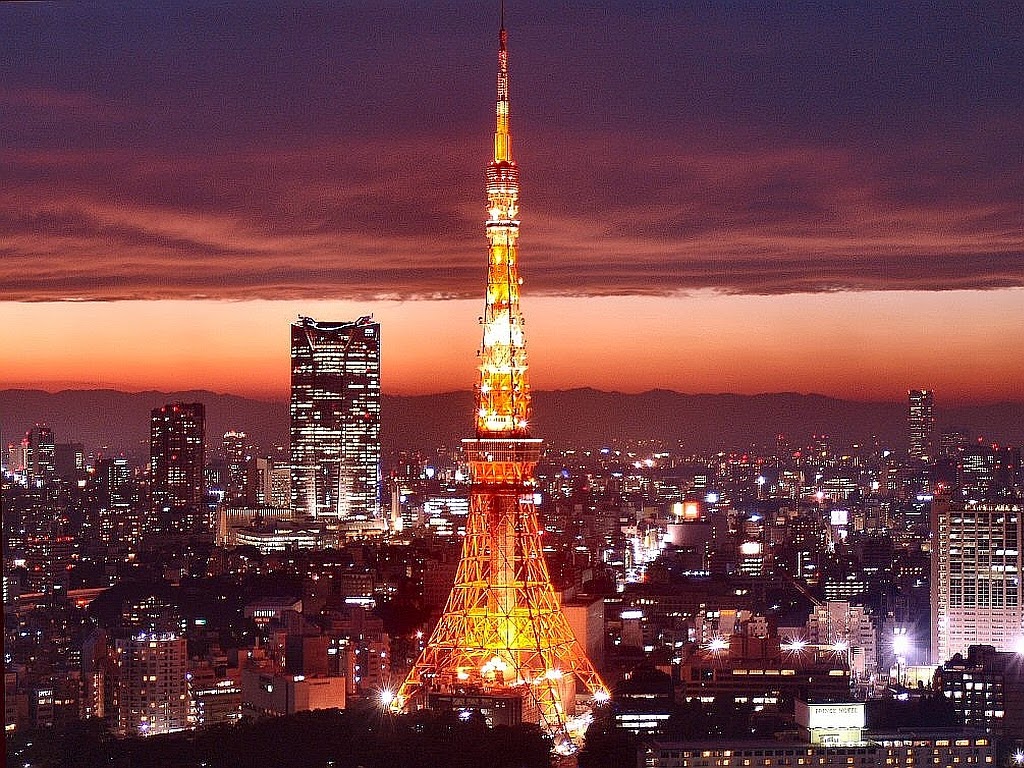
Tokyo Tower is Japan's tallest freestanding tower, 333 meters high. Tower supported by the legs, as vertebral ribs, the tower is painted yellow and clarify a section of white, colorful. The tower is a great launching pad television and radio stations. In the 100 meters high where there is a two-story observatory; at 250 meters high where there is a glass observatory, Tokyo, Tokyo Bay, Izu, Boso Peninsula before your eyes. Lower part of the tower is Tower Building, first floor lounge on the second floor is a shopping mall, the largest in the Far East on the third floor is a first Wax Museum, Science Museum and the fourth floor is the modern TV studio. Hama Rikyu Garden Hama Rikyu Garden garden is the Edo period, located in the southwest end of the central area of Tokyo Tokyo Bay River, an area of ​​26,500 square meters. The park was originally the imperial eagle Tokugawa shogun field. The palace became emperor Meiji era after World War II to the park. It is the waterfront, cited seawater into the pool, is a representative of the Edo period, "Lin Quanting garden style into the lake." Park has a yacht, visitors can take a boat from here to the many attractions in the Gulf of Tonkin to play.


  • Meiji Shirine
Meiji Shrine is dedicated to Emperor Meiji and Empress Shôken Empress and the construction of the shrine, built in 1915 to 1920, during World War II burned, as is rebuilt in 1958, is located in Tokyo's Shibuya district. God palace with all kinds of trees in the more than 10 species of plants, a total of more than 300 kinds. God intrauterine south, north, west three homage corridor, into the right path from the south, roads towering old trees, wild forma. After the Dowager Empress Shôken promising special provision into the Regency, an area of ​​over 80,000 square meters, there are colorful flowers in the garden, especially in the South Regency filled lake iris fields, cultivation of more than 150 kinds of irises, the annual mid-June , large iris bloom and become a major shrine views. Palace halls are built with cypress wood, carved beams are cautious gorgeous, well worth watching. The annual New Year's Day and March 11, there are many who traveled throughout Japan Yasukuni Shrine rushed.


Saturday, March 1, 2014

Taiwan - Formosa

Taiwan island is small, but hidden natural resources and cultural outlook was full of impressive. In terms of natural resources , due to the continuous stratigraphic plate motion , Taiwan have its owns  complex topography , mountains , hills , plains , basins , islands , and coastal landscape. To maintain the beautiful natural landscape and ecological protection, within the set seven national parks and 13 national scenic areas, the essence of Taiwan 's most natural beauty and tourist attractions , including the collection . Not only can visit the magnificent Taroko steep mountain valleys ; take the mountain railway train , shuttling between Alishan sunrise , sea of ​​clouds ; Or climb the highest peak in Northeast Asia - Yushan , witness the changing views of the majestic mountains and the Four Seasons ; came to Kenting in southern Taiwan , a strong smell of the ocean resort feel comfortable, enjoy the " Hawaii of Asia " in the world ; Sun Moon Lake is a shining jewel in the mountains , hills, views of communion must teach people sigh ! The East Coast and Rift Valley , retained the purest natural flavor in eastern Taiwan ; Kinmen and Penghu islands , places rich local characteristics , historical monuments pieced together an impressive style. Taiwan cuts a fine figure as one of Asia’s most diverse destinations.


Taiwan, which also have the names of “Formosa”. Taiwan, a city of 23,184,156 people , lies some 180 kilometers (110 mi) off the southeastern coast of mainland China, which lies across the Taiwan Strait, and has an area of 35,883 km2 (13,855 sq mi). Geographically it covers the majority of the island of Taiwan as well as almost all of its surrounding islands, the largest of which are the Penghu archipelago, Green Island, Lamay Island and Orchid Island. Taiwan Province does not cover territories of the special municipalities of Kaohsiung, New Taipei, Taichung, Tainan, and Taipei, all of which located geographically within main island of Taiwan. It also does not include the counties of Kinmen and Lienchiang, which are located alongside the southeast coast of Mainland China and administered as a separate Fujian Province. The shape of the main island of Taiwan is similar to a sweet potato seen in a south-to-north direction, and therefore, Taiwanese (especially Min Nan speakers) often call themselves "children of the Sweet Potato."


  • Yehliu Geopark

The total distance measured from the entrance of the Yehliu Geopark to the end of the cape is about 1.7km; the widest area in between is shorter than 300m. The distance measured from Yehliu Stop at Jijin Highway to the end of the cape is about 2.4km. The rock landscape of Yehliu Geopark is one of the most famous wonders in the world. The coastal line is stretching in a direction vertical to the layer and the structure line; Besides, the influences caused by wave attack, rock weathering, earth movement and crustal movement all contribute to the formation of such a rare and stunning geological landscape. Yehliu Scenic Area consists of three parts, the first area of fairy shoes, the Queen's head, Valentine stone statue of Lin Tian Zhen and other attractions; second area weathered window, tofu rock, sea trenches, leading stone; Third District lighthouse, turtle stone, Filial Piety Hill, stone beads, stone seals. In addition to the unique geology and rock, a wide range of birds perched on the beach is also not to be missed to watch the goal.


  • CingJing Farm

Passing native forests, through towering gorges, you can immerse yourself in the fresh air and the scenic wild greenery of the Qingjing Veterans Farm.The Qingjing Veterans Farm is situated at the Renai Township of Nantou County,8 km north of Wushe Section, Tai 14A Route of Central Cross-Island Highway in Central Taiwan.It has been opened to public since February 20th, 1961;its altitude is 1,750 meters above the sea. The weather is generally mild all year round. In the months from May to September, the temperatures averages between 15℃ and 23℃. The Farm produces various kinds of fruits including: peaches, pears, plums,and kiwi fruit. Facilities in the Farm include: the Tourist Center, the Green Green Grasslands, the Small Swiss Garden, the Recreation Center for visitors, the Shoushan Park, the Guest House and a Stock Nurturing Center. The working partners of the Farm are putting in all efforts to incorporate the Farm with nearby tourism projects, making it an attraction, to provide a cozy and enjoyable nature trip for all visitors.


  • Formosan Aboriginal Culture Village

Since first opening in July 1986, Formosan Aboriginal Culture Village earned renown for its popular theme area introducing Taiwanese aboriginal culture and for its lush forest and beautiful European Garden. An amusement park and other entertainment attractions have been added to the Village since 1992. Today, the large numbers of completed attractions ensure the position of Formosan Aboriginal Culture Village as a highly competitive and leading edge theme park in Taiwan. Formosan Aboriginal Culture Village has worked consistently and successfully to upgrade its services and facilities. Such efforts have won numerous honors for the Village, including "Premium Award theme park", from government tourism bureau. Formosan Aboriginal Culture Village presently comprises three main theme areas: Aboriginal Village Park; Amusement Isle; and European Garden. The entire Village covers 62 hectares (1,550 acres) and is chock full of sights and attractions to satisfy the whole family.